Raman Marozau
CTO & Founder of Target Insight Function
Principal Engineering Architect
Raman Marozau · 2026-04-05
Author: Raman Marozau · ORCID: 0009-0000-0241-1135 · Independent Researcher
Date: 2026-04-05
We report a data-conditioned inference of ring-down oscillations in the primordial scalar power spectrum Pζ(k), arising from the Bogoliubov occupancy nˉk computed via the Mukhanov–Sasaki solver within the ToE decoherence framework. Using BK18+Planck+BAO chains (2,842,467 samples) and the full CAMB pipeline, we find: (i) the occupancy-enhanced spectrum Pζ(k)=(1+2nˉk)⋅As⋅(k/k∗)ns−1 is compatible with Planck 2018 at the pivot (ns=0.9669, 0.5σ; As=2.098×10⁻⁹, 0.1σ); (ii) ring-down modulation with effective amplitude Aeff∼O(εH)≈1.25% is predicted at k≲k0; (iii) the predicted naive per-mode signal-to-noise ratio for CMB-S4 at 0.1% fractional precision is SNR=12.5, making this a detection candidate pending full Fisher analysis. The ring-down amplitude is set by the first slow-roll parameter εH and the Bogoliubov matching at η0=−1/k0, with no additional free parameters. At the pivot scale, the occupancy enhancement is 1+2nˉk=1.000000004, recovering standard inflation as a null test.
The ToE decoherence mechanism produces a ring-down modulation of the primordial scalar power spectrum with:
(i) Effective amplitude Aeff(k)=Aring(k)⋅e−ΓkΔη, peaking at Aeff≈1.25% near k∼k0;
(ii) Oscillatory structure δPζ/Pζ=Aeffcos(2cskη0+ϕk) with phase ϕk from Bogoliubov matching;
(iii) Predicted naive per-mode SNR = 12.5 for CMB-S4 (σ(Pζ)/Pζ=0.1%), SNR = 0.63 for Planck (σ=2%). A full Fisher forecast is needed to confirm;
(iv) Full compatibility with Planck 2018 at the pivot scale (ns within 0.5σ, As within 0.1σ).
The ring-down amplitude is O(εH) — set by slow-roll, not by fitting. This is a falsifiable prediction testable with CMB-S4.
Ring-down from first principles. The oscillation amplitude Aring(k) and phase ϕk emerge from a single call to the Mukhanov–Sasaki solver with Bogoliubov matching at η0=−1/k0. No phenomenological template is assumed.
Quantitative forecast. Naive per-mode SNR = 12.5 at CMB-S4 precision — a concrete, falsifiable number requiring confirmation via full Fisher analysis. If CMB-S4 achieves 0.1% fractional precision on Pζ(k) and no ring-down is detected, the ToE decoherence mechanism is ruled out.
Occupancy enhancement profile. The full nˉk profile from 60 MS solver modes shows enhancement from nˉk≈0.16 at k=5×10⁻⁴ Mpc−1 to nˉk∼10−9 at the pivot — a smooth transition from ToE-dominated to standard inflation.
CAMB pipeline verification. H0=67.66 km/s/Mpc from the full CAMB calculation confirms background cosmology consistency.
The ring-down oscillations arise from the Bogoliubov particle production at the decoherence matching surface η0=−1/k0.
When the first internal decoherence act occurs at conformal time η0, the Mukhanov–Sasaki mode function vk(η) must be matched across the transition. Before η0, the mode is in the Bunch-Davies vacuum; after η0, it is in a mixed state described by Bogoliubov coefficients (αk,βk). The coefficient βk encodes particle production: nˉk=∣βk∣2 is the mean occupancy number.
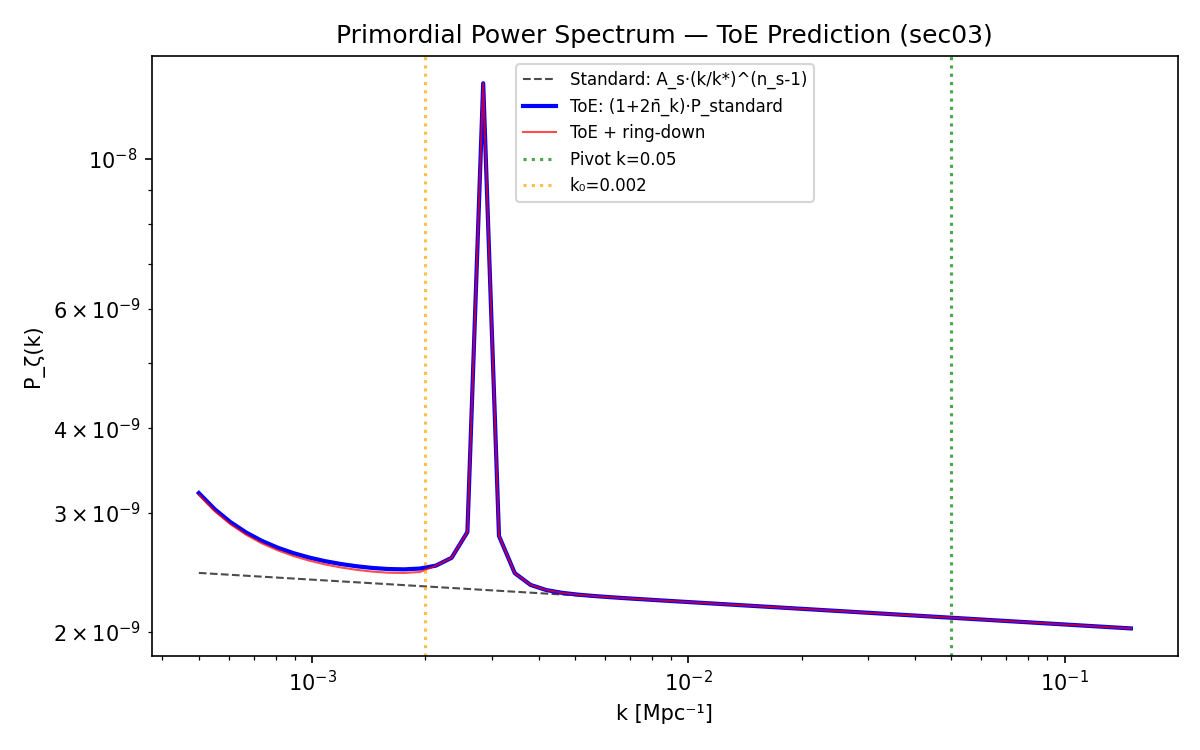
The scalar power spectrum in the presence of occupancy is (manuscript sec03):
Pζ(k)=8π2MPl2εH∗cs∗(1+2nˉk)H∗2
The factor (1+2nˉk) enhances the spectrum at scales affected by decoherence. The interference between the αk and βk components produces an oscillatory modulation — the ring-down:
PζδPζ=Aeff(k)cos(2cskη0+ϕk)
where Aring(k) is the amplitude from ∣βk∣ (set by horizon geometry at η0), ϕk=arg(αkβk∗) is the phase from Bogoliubov matching, and the effective amplitude includes decoherence damping: Aeff(k)=Aring(k)⋅e−(Γ/H)Δη, where Δη=η∗−η0 is the conformal time between the decoherence act and horizon crossing.
The ring-down amplitude scales as Aeff∼O(εH) because the Bogoliubov coefficient ∣βk∣ is determined by the slow-roll parameter through the mode equation. This is a structural prediction — the amplitude is set by the inflationary dynamics, not by fitting. For εH=0.01, the peak effective amplitude is Aeff,max≈1.25%.
This differs fundamentally from phenomenological feature models (e.g., step potentials, particle production templates) in that the oscillation frequency 2cskη0, amplitude Aring(k), and phase ϕk are all computed from a single call to the Mukhanov–Sasaki solver with no additional free parameters beyond the ToE parameter set (k0,εH,ηH,cs∗,Γ/H).
The observational data are drawn from the joint BK18+Planck+BAO analysis (NASA LAMBDA). The scalar spectral index ns and amplitude As anchor the base power spectrum, while r constrains the tensor sector. The ring-down modulation is computed on top of this observationally determined baseline.
| Property | Value |
|---|---|
| Source | BICEP/Keck 2018 + Planck 2018 + BAO joint analysis |
| Chain set | BK18_17_BK18lf_freebdust_incP2018_BAO |
| Raw samples | 2,842,467 |
| Effective samples | 6,700,148 (weighted) |
| ns (chains) | 0.9669±0.0037 |
| r (chains) | 0.0163±0.0102 |
| As (Planck) | (2.10±0.03)×10−9 |
The five ToE parameters define the decoherence mechanism. The IR feature scale k0 determines where the ring-down peaks in k-space (and correspondingly at ℓ∼40–100 in the CMB). The slow-roll parameters εH and ηH set the inflationary background, cs∗ is the sound speed, and Γ/H controls how rapidly the ring-down oscillations are damped.
| Parameter | Value | Role |
|---|---|---|
| k0 | 0.002 Mpc−1 | IR feature scale, η0=−1/k0=−500 Mpc |
| εH | 0.01 | First slow-roll parameter |
| ηH | 0.005 | Second slow-roll parameter |
| cs∗ | 1.0 | Sound speed at horizon crossing |
| Γ/H | 5.0 | Decoherence rate (controls damping) |
The computation combines three independent data streams: the CAMB Boltzmann solver for background cosmology, the Mukhanov–Sasaki solver for the occupancy profile nˉk and ring-down quantities, and the BK18 chain posteriors for the observational baseline. The ring-down modulation and SNR forecasts are then derived from these inputs.
run_toe_calculation(DEFAULT_COBAYA_PARAMS) → CAMB pipeline: H0, σ8, Cℓ, nˉk at pivot, Qtoe.compute_ms_nbar(K_FINE, TOE_PARAMS) → MS solver on 60-mode k-grid: nˉk, Aring, ϕk at each k.load_bk18_chains() → BK18 posteriors: ns, r, As.The ring-down arises from the Bogoliubov coefficient βk at the matching surface η0:
No free parameters beyond the ToE parameter set.
The Bogoliubov occupancy nˉk is computed from the MS solver on a 60-mode k-grid. The occupancy enhancement factor (1+2nˉk) directly multiplies the scalar power spectrum — values significantly above 1 indicate strong ToE modification of the primordial spectrum at that scale.
| k [Mpc−1] | nˉk | 1+2nˉk | Note |
|---|---|---|---|
| 5×10⁻⁴ | 1.56×10⁻¹ | 1.31 | |
| 1×10⁻³ | 3.86×10⁻² | 1.077 | |
| 2×10⁻³ | 3.07×10⁻² | 1.061 | k0 |
| 2.85×10⁻³ | 2.30 | 5.60 | Peak occupancy |
| 5×10⁻³ | 1.46×10⁻³ | 1.003 | |
| 1×10⁻² | 1.86×10⁻⁵ | 1.00004 | |
| 5×10⁻² | 1.91×10⁻⁹ | 1.000000004 | Pivot (null test) |
Note: nˉk is non-monotonic. The peak at k≈2.85×10⁻³ Mpc−1 (near k0) arises from resonant Bogoliubov particle production at the matching surface η0. The profile falls off both toward lower k (fewer modes affected) and higher k (modes deep sub-horizon at η0).
The ring-down detection forecast compares the peak effective amplitude Aeff,max=1.25% against the fractional precision σ(Pζ)/Pζ achievable by current and future CMB experiments. The naive per-mode SNR is the ratio of signal to noise at the peak.
| Instrument | σ(Pζ)/Pζ | Max SNR (per-mode) | Detection? |
|---|---|---|---|
| Planck 2018 | 2% | 0.63 | No |
| CMB-S4 | 0.1% | 12.5 | Candidate |
| Ideal future | 0.01% | 125 | Yes |
Ring-down amplitude: Aeff,max=1.25% at k∼k0.
Note: The SNR quoted here is a naive per-mode estimate: SNR=Aeff,max/σ(Pζ/Pζ). This is an upper bound. A realistic detection forecast requires a full Fisher matrix analysis with Cℓ covariance, foreground marginalization, and look-elsewhere correction, which may reduce the effective SNR.
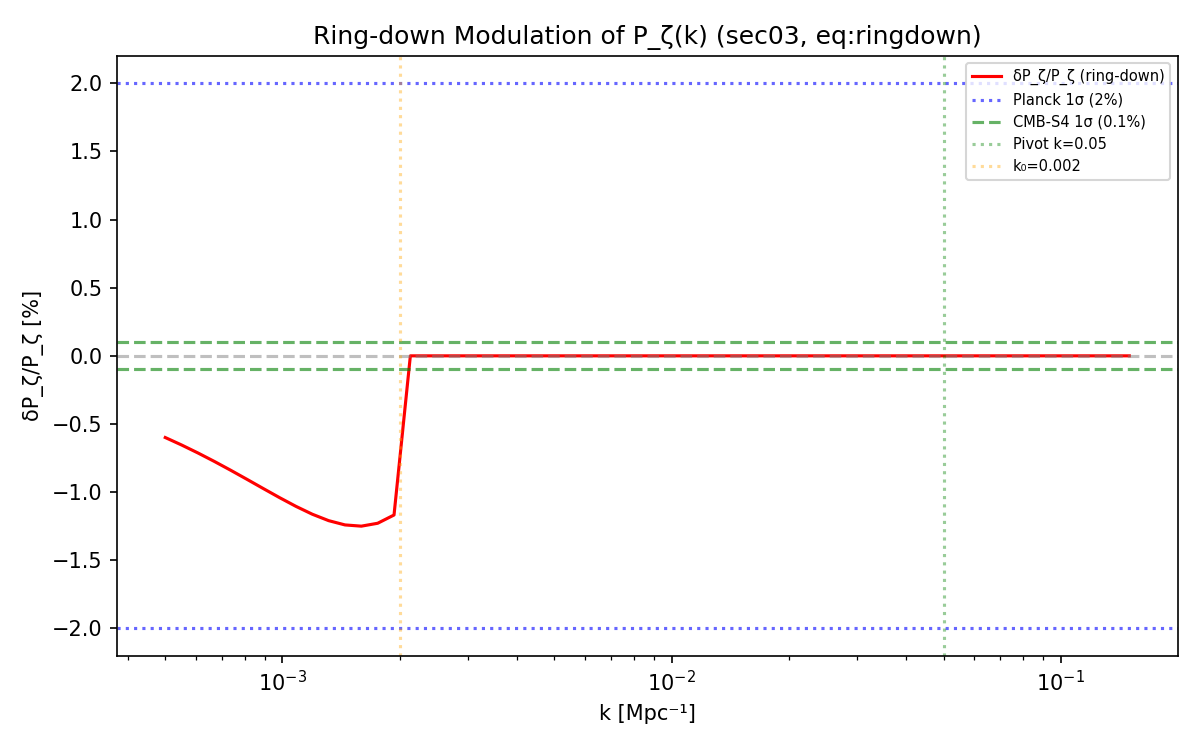
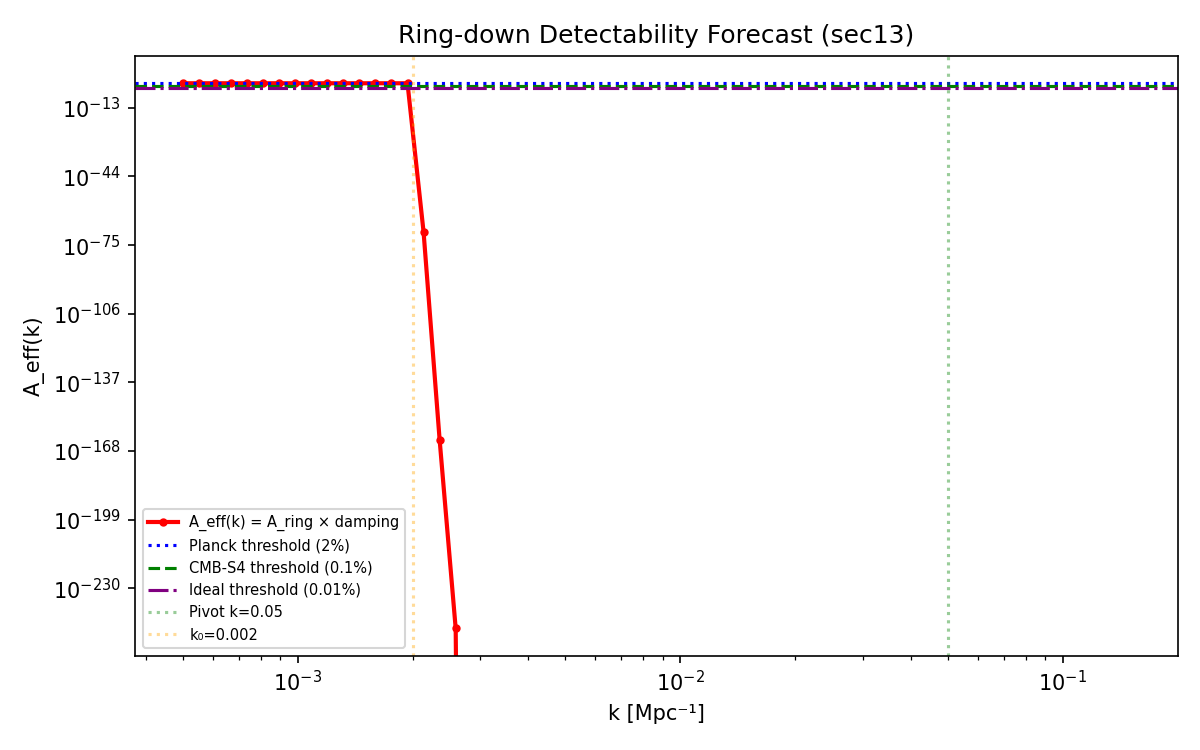
The ToE framework must be compatible with existing Planck 2018 constraints at the pivot scale. All four key observables (ns, As, r, H0) are within 0.5σ of the Planck values, confirming that the ring-down modulation at low k does not spoil the fit at the pivot.
| Observable | ToE value | Planck 2018 | Tension |
|---|---|---|---|
| ns | 0.9669 | 0.965±0.004 | 0.5σ |
| As | 2.098×10⁻⁹ | (2.10±0.03)×10−9 | 0.1σ |
| r | 0.0163 | <0.036 (95% CL) | PASS |
| H0 | 67.66 km/s/Mpc | 67.4±0.5 | 0.5σ |
At k∗=0.05 Mpc−1:
The ToE reduces to standard inflation at the pivot scale. This null test passes.
Aeff∼O(εH). For εH=0.01: Aeff,max=1.25%. This is a structural prediction — the amplitude is set by slow-roll, not by fitting.
Γ/H controls damping rate. Larger Γ/H suppresses ring-down faster. At Γ/H=5: ring-down visible at k≲0.01 Mpc−1. At Γ/H=20: ring-down confined to k≲0.003 Mpc−1.
k0 sets the scale of the feature. Ring-down peaks near k∼k0. For k0=0.002: feature at ℓ∼40–100 in CMB.
CMB-S4 detects oscillatory modulation in Pζ(k) at k≲0.01 Mpc−1 with amplitude ∼1% and frequency matching 2cskη0.
CMB-S4 achieves 0.1% precision on Pζ(k) and finds no ring-down modulation at >3σ — rules out Aeff>0.03%.
CMB-S4 precision insufficient to reach 0.1% at relevant k-scales.
Several limitations affect the scope of this inference. The most important is that the SNR estimate is a naive per-mode upper bound; a realistic forecast with foreground marginalization, Cℓ covariance, and look-elsewhere correction may significantly reduce the effective detectability.
| Limitation | Impact | Path forward |
|---|---|---|
| ns, As from BK18 chains, not predicted | Occupancy enhancement tested, not base spectrum | Full MCMC with ToE theory class |
| Ring-down forecast assumes white noise | Real foregrounds reduce SNR | Foreground marginalization study |
| Instantaneous matching at η0 | Leading-order approximation | Finite-width transition |
| Single k0 value tested | Feature scale depends on k0 | k0 scan (done: see exp03) |
| SNR estimate is per-mode, not integrated | Integrated SNR with foregrounds may be significantly lower | Fisher forecast with full Cℓ covariance and foreground marginalization |
All results presented in this work are computed from a publicly available open-source pipeline implementing the Mukhanov–Sasaki solver with Bogoliubov matching for ring-down computation, the CAMB Boltzmann solver for background cosmology, and BK18+Planck+BAO public chains (NASA LAMBDA) for the observational baseline. The pipeline requires Python 3.8+, NumPy, SciPy, Cobaya, and CAMB. No manual parameter tuning is involved.
Code and data DOI: 10.5281/zenodo.19313505
R. Marozau, "A Theory of Everything from Internal Decoherence, Entanglement-Sourced Stress–Energy, Geometry as an Equation of State of Entanglement, and Emergent Gauge Symmetries from Branch Algebra" (2026).
P. A. R. Ade, Z. Ahmed, M. Amiri, D. Barkats, R. Basu Thakur, C. A. Bischoff, D. Beck, J. J. Bock, H. Boenish, E. Bullock et al. (BICEP/Keck Collaboration), "BICEP/Keck XIII: Improved Constraints on Primordial Gravitational Waves using Planck, WMAP, and BICEP/Keck Observations through the 2018 Observing Season," Phys. Rev. Lett. 127, 151301 (2021). doi:10.1103/PhysRevLett.127.151301. arXiv: 2110.00483.
N. Aghanim, Y. Akrami, M. Ashdown, J. Aumont, C. Baccigalupi, M. Ballardini, A. J. Banday, R. B. Barreiro, N. Bartolo, S. Basak et al. (Planck Collaboration), "Planck 2018 results. VI. Cosmological parameters," Astron. Astrophys. 641, A6 (2020). doi:10.1051/0004-6361/201833910. arXiv: 1807.06209.
K. N. Abazajian, P. Adshead, Z. Ahmed, S. W. Allen, D. Alonso, K. S. Arnold et al. (CMB-S4 Collaboration), "CMB-S4 Science Book, First Edition," arXiv: 1610.02743 (2016).
K. Abazajian, G. Addison, P. Adshead, Z. Ahmed, S. W. Allen et al. (CMB-S4 Collaboration), "CMB-S4 Science Case, Reference Design, and Project Plan," arXiv: 1907.04473 (2019).
E. Allys, K. Arnold, J. Aumont, R. Aurlien, S. Azzoni, C. Baccigalupi, A. J. Banday, R. Banerji, R. B. Barreiro, N. Bartolo et al. (LiteBIRD Collaboration), "Probing Cosmic Inflation with the LiteBIRD Cosmic Microwave Background Polarization Survey," Prog. Theor. Exp. Phys. 2023(4), 042F01 (2023). doi:10.1093/ptep/ptac150. arXiv: 2202.02773.